
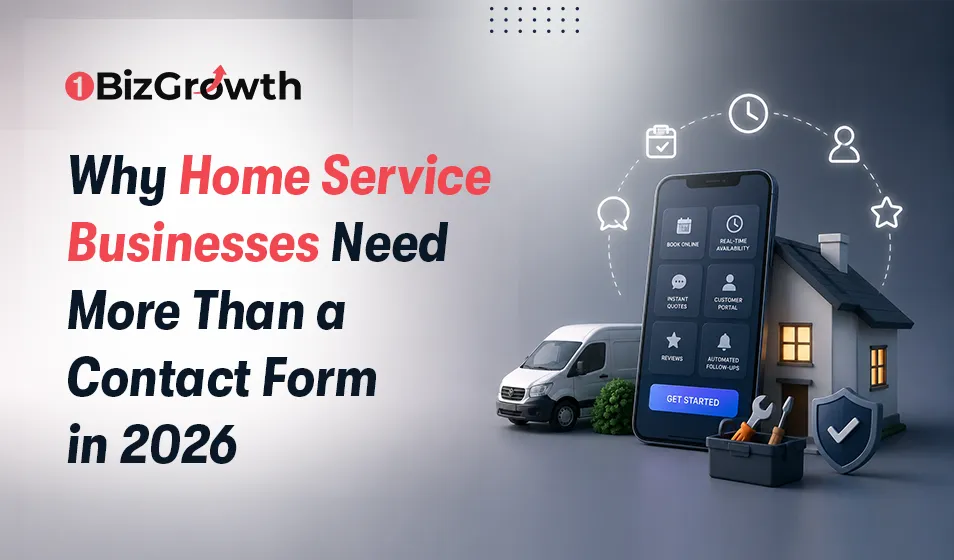
Why Home Service Businesses Need More Than a Contact Form in 2026
A pipe bursts at 9 p.m. Nobody googles a contact form for that. They call, and they call whoever picks up first.
That's the part a website-only lead strategy misses. Roughly 62 percent of calls to home service businesses go unanswered, according to a 2024 ServiceTitan analysis of over 50,000 contractor phone lines, and 78 percent of customers hire whichever company responds to them first. A contact form sitting quietly on your site isn't built to compete with that math. A multi-channel marketing automation setup that catches calls, texts, and forms in one place is.
What a form-only site is losing
Most contractor websites convert 2 to 3 percent of visitors into a submitted form. The other 97 to 98 percent leave without identifying themselves at all, no name, no number, nothing to follow up on.
Even the leads who do fill out a form aren't a sure thing. Phone leads convert 10 to 15 times higher than web form leads in this industry, since a caller with a flooded basement wants a person on the line right now, not a confirmation email that lands in a promotions folder.

Why the phone still runs the industry
Home services is one of the most phone-dependent categories tracked in recent lead studies, with phone leads converting at 46 percent, the highest of any industry measured. A caller in an emergency situation isn't going to sit and type out a project description. They're going to dial, and if nobody answers within a couple rings, they're already dialing the next name on the list.
Roughly two-thirds of callers who hit a missed connection never call back at all. Most of the rest go straight to a competitor. That's not a lead sitting in a queue somewhere. That's a lead gone.
A trade-by-trade example
HVAC shows this clearest. About 68 percent of inbound HVAC calls count as emergency or urgent, and 60 percent of after-hours HVAC calls go unanswered by the contractor who ran the ad that generated them in the first place. Someone spent real marketing dollars getting that phone to ring, and the call just went nowhere.
Plumbing runs the same pattern with burst pipes and backed-up drains. Roofing runs it after a storm. The trade changes. The math where an unanswered call turns into a competitor's job doesn't.
The after-hours gap makes it worse
Somewhere between 35 and 40 percent of inbound calls to home service contractors land outside business hours. Pipes don't wait for Monday morning, and neither do the competitors already running an answering service or an AI receptionist to catch that call at 11 p.m.
A contact form sitting on a website doesn't care what time it is, which sounds like an advantage until you remember that a form submission at 11 p.m. still needs someone to see it, respond, and book the job, usually the next morning at the earliest. By then the emergency's already been handled by whoever answered the phone first.
What 'more than a form' actually means
It starts with catching every channel a customer might use, not just the one your website happens to display. A missed call gets an automatic text within seconds instead of going to voicemail, where fewer than 15 percent of callers ever leave a message anyway.
From there, the lead needs to land in one place your team actually watches, whether it came in as a call, a text, a form, or a Facebook message. Chasing five inboxes to find where a lead landed defeats the entire point of capturing it quickly.
Follow-up needs to run without someone remembering to do it manually too. A quote goes unanswered for two days, and an automatic nudge goes out before the customer forgets they ever asked.
What this changes for a home service business
None of this replaces the technician who shows up and does the job well. It just makes sure that technician actually gets the call in the first place, instead of losing it to whichever competitor answered on the second ring.
A form on a website was never built to handle a business that runs on emergencies, after-hours calls, and a caller who moves to the next name the second nobody picks up. If your lead capture still starts and ends with a contact form, a CRM built for home service businesses closes that gap before the next missed call turns into next week's competitor booking.





