
From Enquiry to Consultation: Designing a Frictionless Professional Services Funnel
Professional services firms don't usually have a lead problem. Someone searches for exactly the kind of help you offer, lands on your site already halfway convinced, and fills out an enquiry form. That part works. What happens between the form and the actual consultation is where the leak lives.
A consultation booked isn't a consultation held, and a consultation held isn't automatically a client won. Every step in between is a place someone can quietly drop off, and most firms never notice because the enquiry still shows up as a "lead" in whatever spreadsheet is tracking it. A CRM built for service businesses closes that gap by tracking the whole journey, not just the first click.
The friction isn't where firms think it is
Most firms spend their energy on the landing page and the ad copy, and that's fair, since intent matters. But the bigger leak usually happens after someone's already decided they're interested. That's the part almost nobody's optimizing.
Self-scheduling is the clearest example. A prospect who can pick a time slot immediately is more likely to follow through than one who gets a ‘we'll be in touch’ message and has to wait for a callback. When scheduling happens instantly instead of manually, prospects can move from interest to a booked consultation without waiting for a callback. That's not a small difference. That's the gap between reaching a prospect while their interest is hot and getting back to them after that interest has cooled.\

Why the first call feels like starting over
A prospect fills out a form describing exactly what they need help with. Then the consultation starts, and the first ten minutes get spent re-asking questions the form already answered. That's wasted time for both sides, and it signals something worse than inefficiency. It signals nobody read the form.
The fix is simple in concept: pull the form responses, any enrichment data, and prior engagement history into view before the call starts. A consultation that opens with "you mentioned X, tell me more about that" lands completely differently than one that opens with a generic qualification script.
The follow-up gap that kills deals nobody thinks are lost
Stalled deals in professional services aren't always lost on price. They can be lost because nobody follows up consistently after a genuinely good consultation. A prospect who says "let me think about it" isn't necessarily saying no. They may simply need more time or another conversation before they're ready to commit.
Firms that only follow up once, right after the call, can leave winnable deals on the table simply by going quiet too soon.
A concrete example
An accounting firm books a consultation with a business owner exploring a switch from their current provider. The call goes well. The owner says they want to discuss it with a business partner first.
No automated follow-up means that conversation quietly stalls, and the firm finds out three months later when the owner signs with someone else instead. An automated sequence checks back after a few days, then again a week later, each touch referencing the actual conversation instead of a generic "just checking in." One of those two approaches catches the deal while it's still warm.
What a frictionless funnel actually looks like
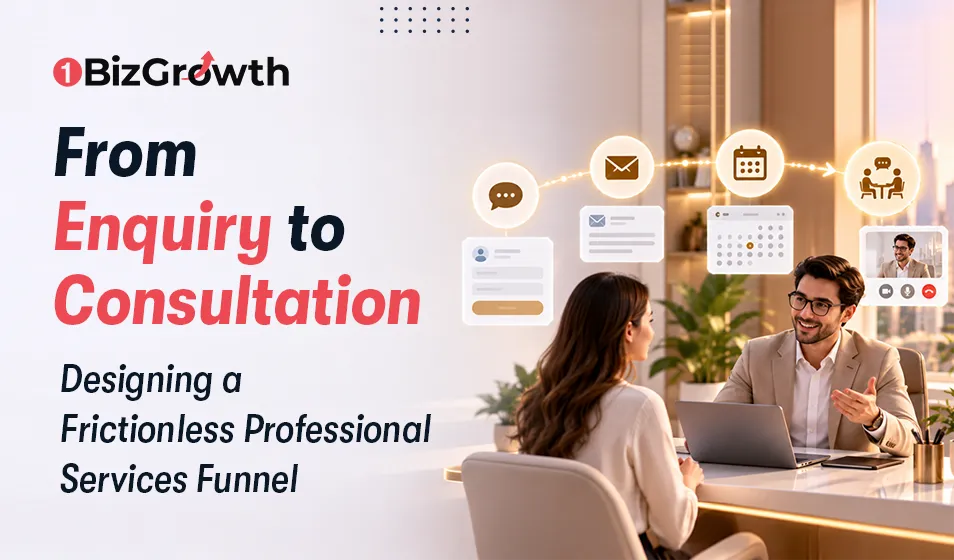
Enquiry submitted, instant confirmation sent. Booking link included immediately instead of a promise to reach out. Reminder the day before, so the no-show rate doesn't quietly eat the pipeline. Pre-call context pulled together automatically, so the consultation starts where the form left off instead of at zero.
After the call, follow-up that references what actually got discussed and is spaced out over the following weeks for anyone who hasn't decided yet. None of that requires a bigger team. It requires the handoffs between each stage to happen automatically instead of depending on someone remembering.
What this looks like day to day
A prospect fills out an enquiry form at 8 p.m. A confirmation and booking link go out within seconds. They book a slot for Thursday. A reminder lands Wednesday afternoon. The consultant opens the call already knowing what the prospect wrote in the form, and the conversation starts on the actual problem instead of restating it.
The consultation goes well, but the prospect wants a few days to decide. A follow-up goes out four days later, referencing the specific conversation, not a generic check-in. That's the difference between a funnel that leaks quietly and one that doesn't. If your firm's enquiry-to-consultation process still depends on someone remembering each step, OneBizGrowth can show you what it looks like when none of it depends on memory.





