
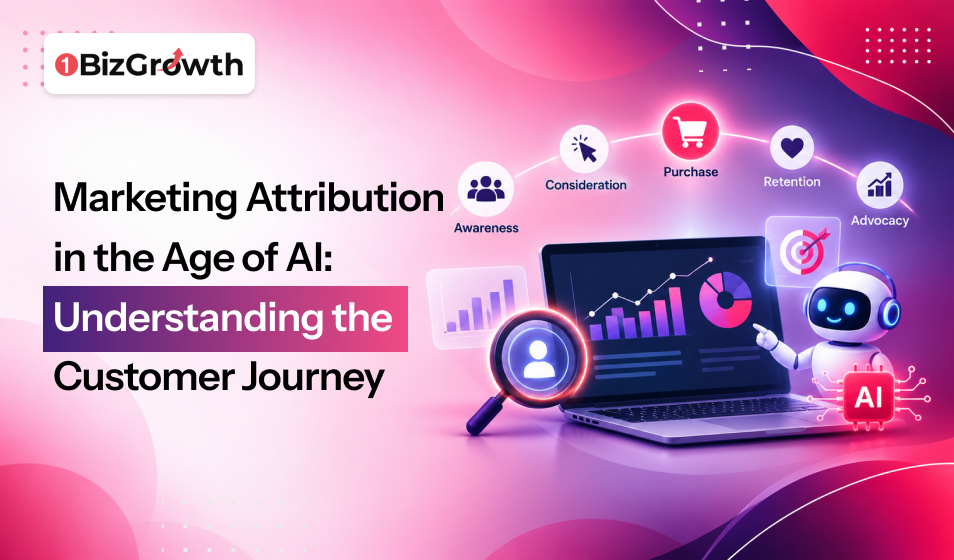
Marketing Attribution in the Age of AI: Understanding the Customer Journey
A customer sees your ad on Monday, reads a review on Wednesday, opens an email on Friday, and buys after a search on Sunday. Which of those earned the sale? Your analytics tool probably gives all the credit to Sunday's click. Your gut says it was more complicated.
That question is marketing attribution, and it has become harder and more important at the same time. This guide explains how attribution works, how AI is changing it, where it still falls short, and how a small team can get useful answers. A good AI marketing attribution software setup starts with the basics below.
What attribution is for
Attribution assigns credit for conversions to the marketing touches that led to them. The point is to decide where to spend it. If you know which channels bring customers and which only look busy, you can move budget with confidence.
Get it wrong, and you cut the channel that starts journeys while feeding the one that merely finishes them.

The classic models
First touch gives all credit to the first interaction. It favors channels that create awareness.
Last touch gives all credit to the final interaction before purchase. It favors channels that close, such as branded search and email.
Linear splits credit evenly across every touch. Time decay gives more weight to touches closer to the sale. Position-based gives most credit to the first and last touches and the rest to the middle.
Each model tells a different story from the same data. None is the truth. They are lenses, and comparing several helps you see where the stories disagree.
Why attribution got harder
Several shifts have made tracking the journey messier.
Privacy changes limit tracking across sites and apps. Browsers restrict third-party cookies, and many people decline tracking altogether. Journeys also cross devices: an ad on a phone, a purchase on a laptop. Much influence happens in places you can't measure, such as private messages, podcasts, and word of mouth.
AI adds another wrinkle. Many people ask AI assistants for recommendations before they ever click a link, and those influences leave little trace in standard reports.
What AI brings
AI can't see what was never tracked, yet it helps in a few real ways.
Data-driven models. Instead of fixed rules, machine learning looks at many past journeys and estimates how much each touch changed the chance of buying. It can notice that customers who read a comparison page convert more often and weigh that touch accordingly.
Gap filling. Statistical methods estimate the effect of channels you can't track directly, using patterns in spend and sales over time.
Identity matching. With consent, systems can link activity from the same person across devices and sessions using the data customers share with you, such as an email address.
Faster insight. AI can scan reports, flag unusual shifts, and summarize what changed, which saves analysts hours.
Where AI falls short
A model can mistake correlation for cause. A channel might look influential because it targets people who would have bought anyway. Models can also inherit bias from the data they learn from, and a black-box score is hard to question.
That's why careful teams pair modeled attribution with experiments. A holdout test, where one group doesn't see a campaign, measures real lift better than any model.
A practical setup for small teams
You don't need a data science department. A few disciplines cover most of the value.
Tag everything. Use consistent campaign tags on every link in ads, emails, and social posts. Messy tags are a common cause of unreadable reports.
Capture the source. When a lead fills a form or books a call, store where they came from on their record, along with the first and most recent touch.
Ask people. Add a simple "How did you hear about us?" question. Self-reported answers catch podcasts, referrals, and AI recommendations that tracking misses.
Track the whole funnel. Follow leads from first visit to enquiry, qualified lead, deal, and revenue. Attribution that stops at the click ignores what happens afterward.
Compare views. Look at first-touch and last-touch results side by side. Where they differ most, you've found channels worth testing.
Test for lift. Pause or hold back a channel for a small group now and then, and see what changes.
Connect marketing to revenue
Clicks and leads are easy to count. Revenue is what counts. Link your marketing data to your CRM and pipeline so you can see which sources produce paying customers, how fast they close, and what they're worth.
You may find that a cheap source of leads brings few buyers, while a pricier one brings the clients who stay.
Respect privacy
Collect only what you need, explain it in plain language, and honor opt-outs. Rules differ by region, so check what applies to you. Good consent practice also protects the quality of your data, since permission-based data is the kind that lasts.
Common mistakes
Trusting one model as the full story.
Skipping consistent campaign tags.
Measuring leads and ignoring revenue.
Treating a modeled number as an exact fact.
Changing tools every quarter and losing history.
Start where you are
Pick the questions that matter most, such as where to put next month's budget. Set up tagging, capture sources in your CRM, and review a simple report monthly. Add modeling and testing as your data grows.
Journeys begin at landing pages and forms, so track them closely. A sales funnel tracking tool shows where visitors enter, where they drop off, and which pages turn interest into enquiries.





