
The Hidden Cost of Using 8 Business Tools (And the Fix)
Open your laptop right now. Count the tabs.
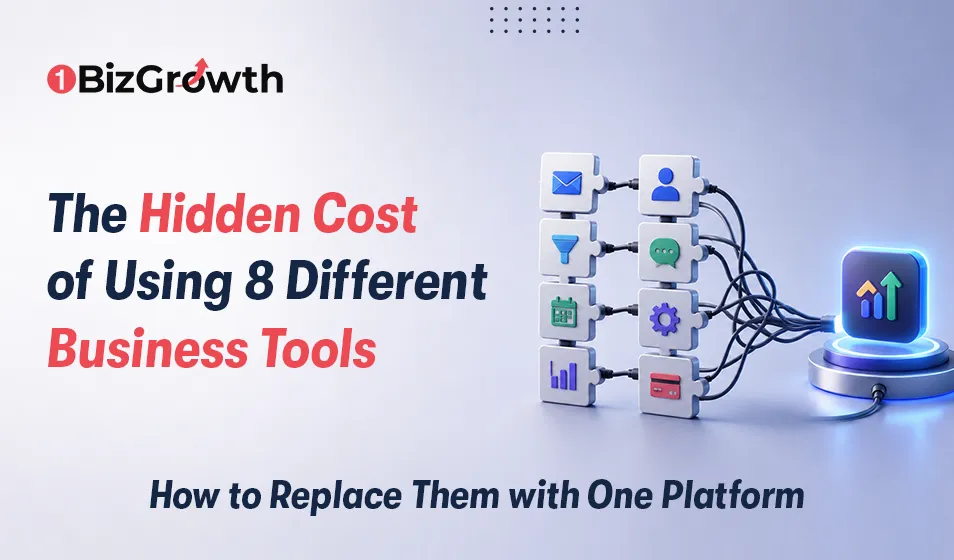
Odds are you've got a CRM in one, email in another, a texting app, a scheduler, a funnel builder, an invoicing tool, an ad tracker, and a review widget somewhere in the mix. Each one does its job fine. None of them talk to each other. And that gap is costing you more than the subscription fees. OneBizGrowth was built to close it by folding all eight into one platform.
What running 8 tools actually costs you
Nobody plans this. You grab a CRM in year one. A texting platform in year two. A funnel builder once marketing picks up. A scheduling app once your calendar turns into a mess.
One tool at a time, it adds up. Then the renewal charges hit your card on the same week, and you finally add up the damage:
Two or three tools doing the same job for different teams.
Hours lost copying data between platforms instead of talking to leads.
A lead fills out a form in one tool while sales is watching a different one.
A competitor calls your lead before your CRM even shows the entry.
Five dashboards, five numbers, no single view of how the business is actually doing.
Run the math on a typical stack. A CRM at $50 a month. Email marketing at $40. A texting tool at $30. A scheduler at $20. A funnel builder at $75. An ad tracker at $30. Invoicing at $25. A review tool at $20.
That's $290 a month, before you count the hours your team spends bouncing between all eight logins. And most of that money is paying for overlap, not new capability.

What one platform actually replaces
An all-in-one platform is a single system where your CRM, automation workflows, funnels, pipelines, and scheduling all pull from the same data. When a lead moves, every part of your business sees it move.
OneBizGrowth runs on this. Instead of stitching together separate apps for your CRM, automation, sales pipelines, and funnel builder, you run all of it from one dashboard, on one login.
What your day looks like once it's connected
A lead fills out a form on your site at 9 p.m. In a fragmented setup, that lead sits in an inbox until someone checks it the next morning.
On a connected platform, the lead gets captured on the spot, dropped into a pipeline stage, and triggers a text or email within minutes. Here's what that looks like day to day:
Lead capture from every social and web channel, in real time.
Automated workflows across email and SMS that fire without anyone touching them.
One inbox for email, SMS, and WhatsApp instead of three separate apps.
Visual pipelines that show exactly where every deal sits.
One dashboard for revenue, conversions, and pipeline health.
A quick gut check
Ask yourself these, honestly:
Do two people on your team update the same lead in two different tools?
Have you ever lost a lead's history because a subscription lapsed?
Could you pull last month's revenue, conversion rate, and pipeline value in under a minute, from one screen?
If you hesitated on any of those, the eight-tool setup isn't saving you money. It's just hiding the cost somewhere you're not looking.
What you actually gain
Response times drop, because leads don't sit in a queue between two systems. Your sales team spends less time on data entry and more time on the phone.
And the follow-up stops depending on someone remembering to check a second inbox. That's the real payoff: fewer leads falling through the gap between two systems that were never built to talk to each other.
Bringing it all together
Running eight tools feels normal because it happened one subscription at a time. Every renewal, every hour spent copying data, every lead lost in a gap between systems adds up to a cost most businesses never sit down and calculate. OneBizGrowth puts your CRM, automation, funnels, pipelines, scheduling, and communication under one roof, so your team spends less time managing software and more time closing deals. If eight tabs and eight invoices sound familiar, it might be worth seeing what one platform feels like.





