
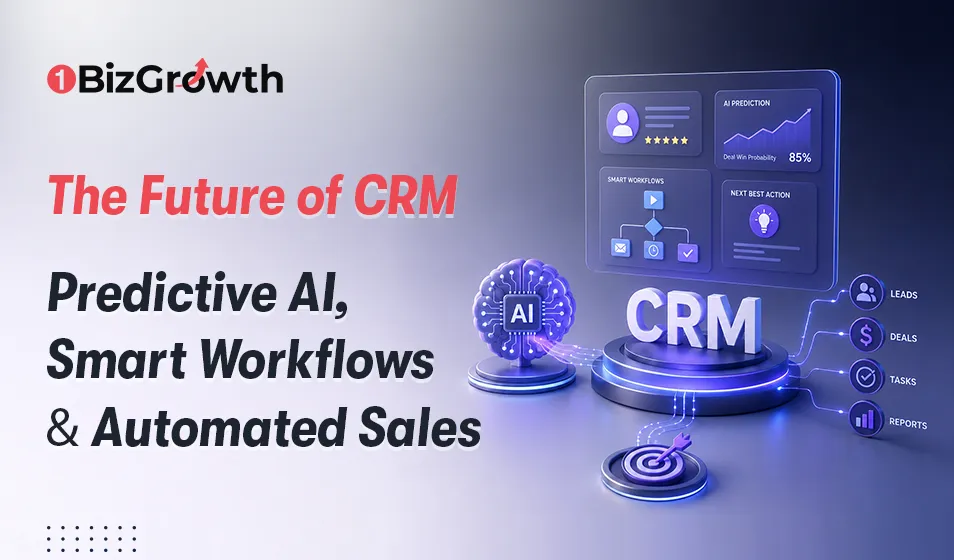
The Future of CRM: Predictive AI, Smart Workflows & Automated Sales
Most CRMs still work like a filing cabinet with a search bar. You put data in, you pull data out, and every decision about what to do with it sits on a person.
That's changing fast. Businesses running generative AI inside their CRM are 83 percent more likely to hit their sales targets, according to Salesmate's 2026 industry data. The software isn't selling for them. Advanced CRM software with predictive scoring just tells reps who to call first, instead of leaving that call to a gut feeling and a coffee.
What 'predictive' actually means
Old CRM: a list of leads sorted by date added. New CRM: a list of leads sorted by who's actually going to buy.
Predictive scoring looks at what closed deals had in common, response time, page visits, email opens, deal size, and ranks new leads against that pattern. A rep working 40 leads doesn't guess which five matter most. The system already told them, before the first call gets made.

What smart workflows do
A basic automation fires the same email no matter what happens next. Someone opens it, someone ignores it, same follow-up either way.
A smart workflow reads the response and branches. Open the email twice and click nothing, and it waits two more days before nudging again. Click through to pricing, and a rep gets pinged immediately instead of a week later. The workflow adjusts to the lead's actual behavior instead of running the same script on everyone.
What gets automated on the sales side
Data entry disappears first, usually. Calls get logged automatically, emails get summarized, and a rep's CRM updates itself instead of eating twenty minutes at the end of every day.
Follow-ups run on their own too. A quote goes unanswered for four days, and the system sends a check-in before the rep even notices the silence. Meeting scheduling stops being a five-email back-and-forth, since the system just shows open slots and books the one the lead picks.
Forecasting gets sharper as a side effect of all this. When the system already knows deal stage, response patterns, and historical close rates, guessing next quarter's number turns into reading a number the data already calculated.
The part that trips most teams up
Predictive scoring is only as good as what you've been feeding the CRM. Duplicate contacts, deals logged three weeks late, half the team skipping fields they think don't matter: all of that quietly wrecks the pattern the AI is trying to learn from.
A team with six months of clean, consistent data will get sharper lead scores than a team with three years of messy data. Before chasing the AI features, it's worth an afternoon checking whether your pipeline stages actually get updated in real time, or whether they're three weeks stale by the time anyone looks.
What stays human
Nobody's automating the actual conversation where a prospect airs a real objection and a rep talks them through it. Negotiation, trust, reading a room, the parts of selling that depend on picking up on something a spreadsheet can't see. That stays with the person.
What the AI removes is everything standing between a rep and that conversation. Fewer spreadsheets. Fewer "just checking in" emails typed from scratch. More actual selling.
What this looks like on a Tuesday
A rep opens their CRM. Instead of forty leads in a flat list, three are flagged as ready to buy this week, based on activity from the last 48 hours. A fourth lead just got an automated nudge after going quiet for five days. Two meetings booked themselves overnight because a lead picked a slot straight off the calendar link.
None of that took the rep's morning. It happened while they were still on their first coffee.
The math behind it holds up too. Industry data puts average CRM returns around $8.71 for every dollar spent, and teams running clean automation report saving five to ten hours a week that used to go to manual data entry. That's not a rounding error. That's most of a workday, every week, per rep.
Where this is heading
CRM used to mean storage. Now it means a system that tells you what to do next and does half of it without being asked. That shift isn't slowing down, and the gap between teams running predictive workflows and teams still working off a spreadsheet keeps getting wider every quarter.
If your sales team is still guessing which lead to call first, a smart CRM platform built around predictive scoring and automated workflows closes that gap without adding a single rep to the team.





