
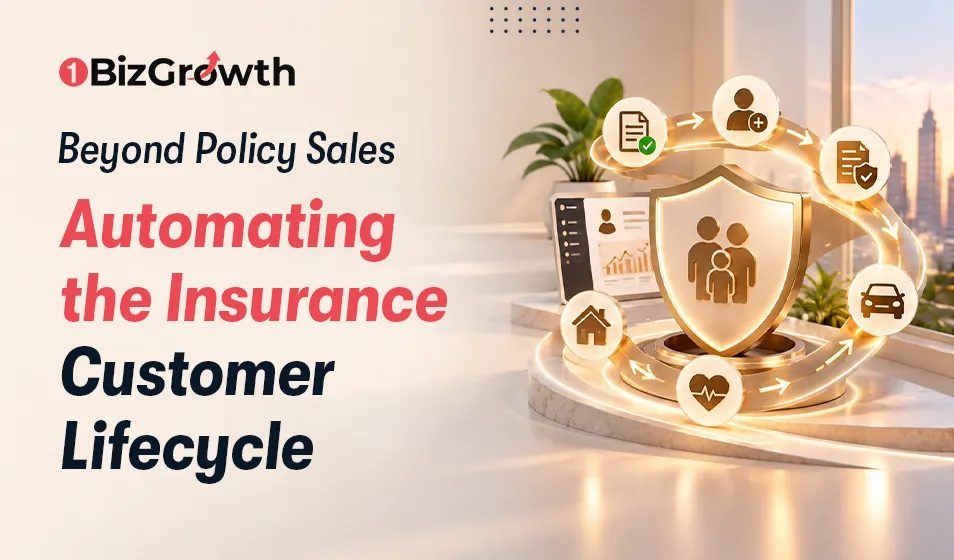
Beyond Policy Sales: Automating the Insurance Customer Lifecycle
Most agencies automate the one moment in the policy lifecycle that's already the easiest to get right: the quote. The moment that actually decides whether the client stays, the renewal, still runs on a spreadsheet and someone's memory.
41 percent of independent agencies still rely on manual renewal outreach with inconsistent timing, according to IIABA's 2025 Independent Agency Operations Survey. That's remarkable given that renewal is the one event in the entire relationship that's 100 percent predictable by date. An Advanced CRM track what happens after the sale, not just the sale itself.
What 'beyond policy sales' actually covers
Quoting and binding get the most attention because they're the most visible part of the job. Everything after that, service requests, renewal outreach, cross-sell conversations, claims support, tend to run on whatever a CSR remembers to do between calls.
That's the part of the lifecycle where most of the actual relationship gets built or lost, and it's also the part most agencies never automated in the first place.

The renewal blind spot hiding under healthy numbers
US property and casualty retention averages around 84 percent for personal lines, which sounds solid until you look forward to intent instead of the historical number. Only 51 percent of high-value customers say they'll definitely renew, according to J.D. Power's 2026 insurance industry outlook, and 57 percent of auto policyholders shopped for their coverage in 2025, up from 49 percent the year before.
Headline retention describes what has already happened. It says nothing about the churn quietly building underneath it, and renewal decisions get made weeks before the actual renewal date, not on it.
Why renewal gets treated like a surprise anyway
Automated renewal outreach improves retention by 12 to 22 percent compared to manual processes, according to Applied Systems' 2025 Agency Management Benchmark Report. For a $5 million book at 85 percent of retention, moving to 92 percent would retain roughly $350,000 more in premium a year.
The math is straightforward enough that the gap is hard to explain any other way than habit. Renewal timing is the one date on the calendar an agency has known about since the policy was written and treating it as a fire drill every year is an expensive way to run the most predictable event in the business.
What automated lifecycle tracking actually catches
Lapse decisions don't always happen on the day a policy expires. They can be preceded by behavioral signals weeks or months out: a client who stops opening renewal emails, a premium increase that triggers a shopping search, a claim that went poorly and never got a proper follow-up. None of that shows up in a system that only tracks quote-to-bind.
A lifecycle-aware CRM can help surface those signals while there's still time for a person to intervene. The same way a health score catches a SaaS customer drifting toward cancellation before the renewal date arrives.
Service requests add up faster than agencies expect
Commercial lines agencies issue certificates of insurance constantly, and each one typically takes 15 to 30 minutes of manual work: verifying policy details, generating the document, routing it for approval. None of that touches the actual sale, and none of it shows up in a quote-to-bind view of the business.
Multiply across a book with hundreds of commercial accounts, and service work quietly becomes a full-time job hiding inside everyone else's job description.
Cross-sell is a retention strategy, not just a revenue one
Households with three or more policies retain at 96 percent, compared to 78 percent for single-policy households, according to J.D. Power's 2025 Insurance Loyalty Study. Automated cross-sell outreach converts 18 to 28 percent, against 8 to 12 percent for manual outreach, per Forrester's 2025 research.
A client who only has an auto policy is a client who's only one comparison-shopping habit away from leaving entirely. A client with auto, home, and life coverage under one agency has three separate reasons to stay put.
What this looks like day to day
The policy renews in 45 days. The system flags it automatically, checks whether the premium increased more than 15 percent, and if it did, queues a coverage review call instead of a routine renewal notice. A CSR who would've missed that increase buried in a spreadsheet gets the context handed to them instead.
Personalized retention outreach based on behavioral data makes a client 2.8 times more likely to renew compared to a standard notice, according to Salesforce's 2025 Insurance Industry Report. If your agency's automation stops at the quote and everything after runs on memory, OneBizGrowth can show you what tracking the whole relationship actually looks like.





