
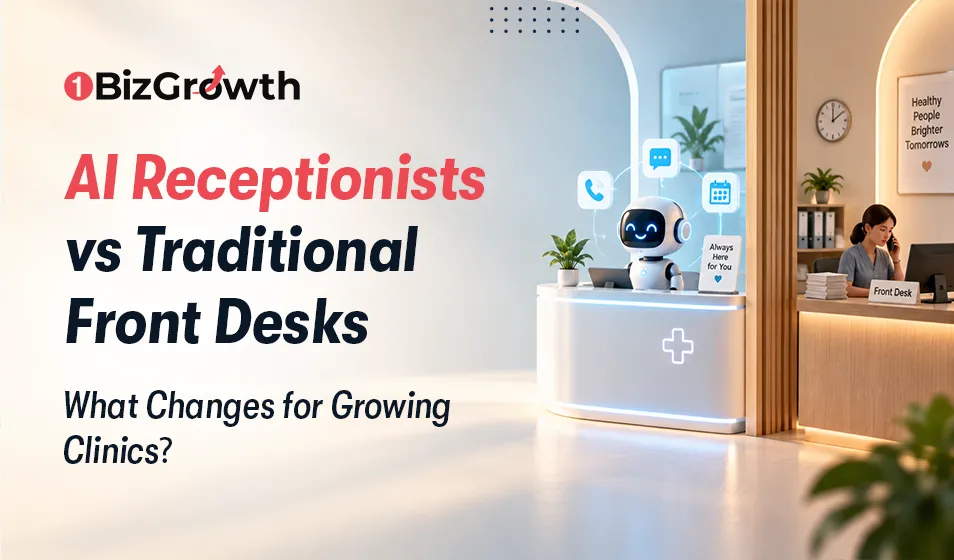
AI Receptionists vs Traditional Front Desks: What Changes for Growing Clinics?
A front desk coordinator can only be on the phone or at the counter, never both. Growth just makes that gap show up more often, not less.
The average multi-physician practice loses more than $150,000 a year to missed calls and abandoned hold times, according to a 2025 patient communication report. That's not a staffing failure. It's a structural one: one person answering phones can't also check in the patient standing in front of them. A CRM built for healthcare communication with AI call answering built in removes the part of the job that was never possible to do well in the first place, without touching the part that person actually handles best.
What a traditional front desk still does better
A returning patient who's anxious about a diagnosis, a family member asking a sensitive question at the counter, a walk-in who needs someone to read the room and adjust: none of that gets handed to software. A good front desk coordinator reads tone, catches what a patient isn't saying, and makes judgment calls no script anticipates.
That part of the job doesn't get automated well, and clinics that try to automate all of it usually end up with patients who feel like they're talking to a wall. The in-person and emotionally sensitive parts of the front desk role are exactly where a human stays.

Where the traditional model breaks under growth
Medical practices miss 25 to 30 percent of incoming calls on average, mostly not from inattentiveness but from structural capacity: a medical assistant rooming a patient, a coordinator managing a check-in line, a nurse returning yesterday's calls. Nobody's available when the phone rings, because everyone's already doing something else that also matters.
Lunch hours make it worse. In one audited cohort of clinics, more than a third of daily call volume landed between noon and 2 p.m., the exact window when front desk coverage thins out. After-hours calls compound the problem further: roughly 41 percent of patient calls come outside business hours, when the office isn't staffed at all.
What an AI receptionist changes
It answers every call simultaneously, regardless of how many arrive at once, at any hour. It books directly into the practice's scheduling system rather than taking a message for someone to act on later, and it can triage an urgent call differently than a routine reschedule request.
None of that requires replacing staff. It requires routing the calls that would've gone unanswered to something that can actually pick up, so the front desk isn't choosing between the patient on the phone and the one at the counter.
A concrete scenario
A patient calls at 7:45 a.m. to reschedule an appointment before the office technically opens. Under the traditional model, that call goes to voicemail, and roughly 62 percent of patients who hit voicemail hang up without leaving a message, and don't call back. The appointment slot sits empty, and nobody finds out until the patient doesn't show.
With AI call answering live, that same call gets picked up, the reschedule gets booked directly into the practice's system, and the slot gets reopened for someone else before the office even unlocks its doors.
What the cost comparison looks like
A part-time human receptionist runs $1,500 to $2,500 a month before overhead. AI receptionist services built for healthcare typically run $300 to $500 a month with HIPAA compliance and EHR integration included. Neither replaces the other completely, but the math behind adding AI coverage is straightforward: recovering even a handful of missed appointments a month, each worth $150 to $450 in new-patient revenue, covers the subscription many times over.
The bigger number is what gets lost without it. Patient no-shows and missed calls together cost the U.S. healthcare system well over $150 billion annually, and 41 percent of patients report switching providers at least partly over difficulty reaching the practice by phone. That's not a lost call. That's a lost patient relationship.
What this looks like combined
The clinics getting this right run both, not one instead of the other. AI answers the calls that arrive during the lunch rush, after hours, or when three lines ring at once. The front desk handles what's standing in front of them, the walk-ins, the sensitive conversations, the moments that need a person reading the room.
Neither side replaces the other. The AI closes the gap that was never a fair job for one person to cover alone. If your clinic's front desk is stretched thin during exactly the hours patients call most, OneBizGrowth can show you what that coverage actually looks like without adding another full-time hire.





